


Lead-Safe Wisconsin: Childhood Lead Poisoning Data
Key information
Wisconsin's Childhood Lead Poisoning Prevention Program (CLPPP) tracks childhood lead testing and poisoning rates.
The only way to know if a child has been exposed to lead is through a blood-lead test.
Wisconsin recommends that all children receive a blood lead test at age 1 and age 2, or at least one blood lead test between ages 3 and 5 if not previously tested.
Where to find lead poisoning or testing data
- CLPPP provides updates on childhood blood lead testing and lead poisoning rates, provided below.
- Visit the Environmental Public Health Tracking (EPHT) Program's page on lead poisoning:
Can't find what you're looking for?
Submit a request with the Data Resource team:
About Wisconsin's childhood lead poisoning data
The state of Wisconsin collects data about childhood blood lead testing and poisoning rates. The state uses this data to inform rule changes, health recommendations, and outreach efforts. Recent changes include:
- 2024: Wisconsin's Childhood Lead Poisoning Prevention Program updated its blood lead testing recommendations. The state now recommends that all children receive a blood lead test at age 1 and age 2, or at least one blood lead test between ages 3 and 5 if not previously tested.
- Since Wisconsin updated its blood-lead testing recommendations, the state has seen a 26% increase of blood lead testing rates in children under the age of 6.
- 2025: Governor Evers approved an emergency rule to lower Wisconsin's definition of lead poisoning from 5ug/dL to 3.5ug/dL.
"No amount of lead exposure is safe for kids, and even the smallest exposure to lead can have serious, long-term consequences impacting kids' learning capacity, ability to pay attention, and academic achievement. That's why, to kick off the year, I approved an emergency rule to lower Wisconsin's lead poisoning threshold, making more kids and families eligible for intervention resources, and I'm proud of our work to screen more kids across the state so that we can get these critical resources to folks and families who need them."
- Gov. Tony Evers, National Lead Poisoning Prevention Week, 2025
How do we gather childhood blood lead testing data?
Wisconsin's childhood blood lead testing data is gathered through the Healthy Homes and Lead Poisoning Surveillance System (HHLPSS). HHLPSS tracks:
- Blood lead test results.
- Property addresses associated with blood lead test results.
- Case management activities.
- Lead hazard investigations.
- Lead hazard remediation.
The Childhood Lead Poisoning Data Explorer Map
The Childhood Lead Poisoning Data Explorer Map shows lead testing and poisoning data for Wisconsin children under age 6. Data is broken out by census tract.
View the Childhood Lead Poisoning Data Explorer Map
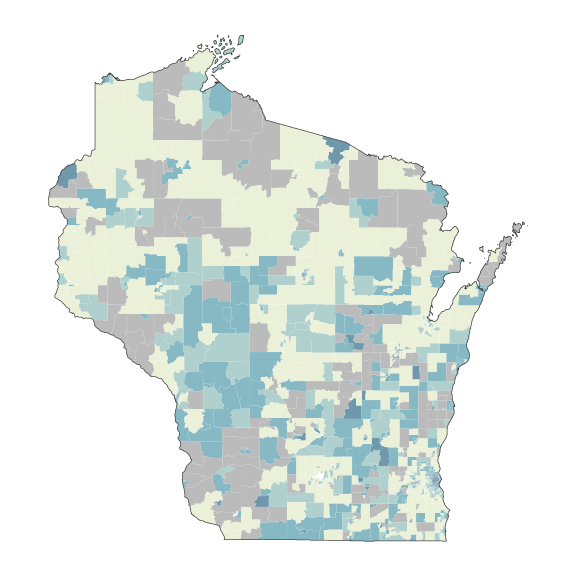
Important note: The data in this application is from 2021, which is before Wisconsin updated its definition of lead poisoning to a blood lead level ≥3.5ug/dL. This application is currently undergoing updates. We appreciate your patience as the data is updated.
Statewide blood lead testing trends
For data visualization, such as graphs, visit the Environmental Public Health Tracking Program (EPHT)'s data dashboard:
Visit EPHT's lead poisoning data dashboard
Number of children tested for lead poisoning (birth to <6 years), 2015 to 2025
Notable information from this table:
- Before 2020, Wisconsin was testing an average of 88k children under age 6 per year.
- There was a drop in lead testing during 2020, when many clinics and resource centers moved to virtual platforms during the COVID-19 pandemic.
- In 2024, testing rates recovered, following an update to Wisconsin's blood lead testing recommendations.
| Year | Number Children Tested <6 years |
|---|---|
| 2015 | 86,784 children |
| 2016 | 89,081 children |
| 2017 | 90,486 children |
| 2018 | 88,945 children |
| 2019 | 85,371 children |
| 2020 | 66,684 children |
| 2021 | 66,707 children |
| 2022 | 69,497 children |
| 2023 | 75,359 children |
| 2024 | 100,937 children |
| 2025 | 96,676 children |
Past data
The reports below reference the blood lead level that reflected the CDC’s guidance at the time: