


Environmental Health: Soil Quality
Sometimes there are harmful chemicals in the soil that can make it unsafe for regular use. Children and adults can be exposed to harmful substances in the soil when gardening, playing in bare soil, eating produce grown in contaminated soil, swallowing soil particles, or breathing in dust from contaminated soil. Contaminated soil can also be tracked indoors on shoes, clothing, or from pets.
Children are most at risk of exposure to contaminated soil because they engage in behaviors like putting their hands in their mouths and crawling and playing on the ground.
Following soil safety recommendations when gardening or playing outside can lower your risk of coming into contact with harmful chemicals that may be in the soil. The Wisconsin Department of Health Services (DHS) Site Evaluation Program partners with communities to host health education programs on soil safety, called soilSHOPS.
Families and early care and education (ECE) providers can learn more information about nutritious fruits and vegetables, including how to start a school or community garden, by visiting the Nutrition and Physical Activity Early Care and Education Initiative webpage.
Soil safety recommendations
Safe gardening practice recommendations
Following safe gardening practices may help you lower your risk of coming into contact with contaminated soil. You can take the following actions to lower your risk and prevent exposure to contaminants in soil.
Practice good habits and personal behaviors while gardening:
- Wash hands after gardening and before eating or drinking.
- Wear gloves when gardening and use gardening tools when working with soil.
- Avoid bringing clothing, shoes, gloves, and gardening tools inside to avoid tracking soil from the garden or play area indoors. Heavily soiled clothing should be bagged before being brought indoors and washed separately.
- Avoid eating, drinking, or smoking when working in the garden.
- Wash produce before eating or storing. Root vegetables should be peeled and leafy vegetables should have the outer leaves removed.
- Keep an eye on children and pets to avoid exposure to contaminated soil.
Grow produce in safe ares by following these recommendations:
- Avoid planting edible leafy vegetables, herbs, and root vegetables in contaminated soil. These types of produce are more likely to take up contaminants.
- Fruiting plants (like peppers and berries) are less likely to take up contaminants from contaminated soil, but it is best practice to move these to an area without contaminated soil as well.
- Use a raised garden bed (PDF), container gardens, green walls, or rooftop gardens to plant fruits and vegetables if you have contaminated soil. Hydroponics, or growing plants in water, can also be used if you have contaminated soil.
Using physical control strategies can prevent contaminated soil from moving into clean soil.
- Plant your garden away from roadways or build a border around your garden to avoid windblown contamination.
- Cover existing bare soil walkways with mulch, gravel, or landscaping items like stones or bricks.
- Add mulch in your garden to help reduce dust and soil movement.
- Fill garden beds, container gardens, and rooftop gardens with bagged soil to avoid contact with contaminated soil.
- Remove, replace, or remediate contaminated soil.
Outdoor play area recommendations
Prevent children from coming into contact with contaminated soil and reduce their exposure to harmful substances in the soil by:
- Washing children’s hands when they come inside after playing outdoors.
- Washing toys that have been outdoors before bringing them inside.
- Having play areas away from bare soil. Provide a play space with grass, mulch, wood chips, or sand.
- Having children eat or drink in areas away from bare soil.
- Keeping children away from other sources of lead like peeling or chipping paint that could create dangerous lead dust.
- Reading the Consumer Product Safety Commission’s Guidance for Outdoor Wooden Structures (PDF) if you have a playground, picnic table, fence, or deck that may be constructed with wood pressure-treated with Chromated Copper Arsenate (CCA).
What is a soilSHOP?
Soil screening, health, outreach, and partnership (soilSHOP) is a community event that offers free soil screening for heavy metals like lead and arsenic for the general public and child care providers. Bring a sample of soil from your garden or outdoor play area to a soilSHOP event to get same day screening results and health education on soil safety and recommended gardening practices based on your results.
Interested in partnering to host a soilSHOP in your community? Get in touch (DHSEnvHealth@dhs.wisconsin.gov)!
Upcoming soilSHOP events
Check back here for soilSHOP events near you!
What to know before you go to a soilSHOP event
A soilSHOP event is an opportunity to learn more about possible hazards that may be in the soil in your home or at the child care center you operate.
Previous uses of lead in paint, leaded gasoline, and industry practices have resulted in soil becoming contaminated with lead over time. Even though lead in paint and leaded gasoline are no longer used today, structures built before 1978 are likely to still contain lead-based paint. Getting your soil screened for lead is recommended if you have structures built before 1978 on your property or live in an area with historical mining and industrial activity.
Arsenic, specifically chromated copper arsenate (CCA), was previously used in residential pressure-treated wood products like decks, fences, and playgrounds to control rot and termites until 2003. CCA is still used in industrial settings today. Arsenic was also previously used as a common pesticide in orchards that has resulted in potential soil contamination in these areas. Getting your soil screened for arsenic is recommended if you have old pressure-treated wood products or live in an area with historical agriculture, mining, or industrial activity.
Lead and arsenic in soil can still be a problem because of these previous uses since these harmful substances can stay in the environment for a long time. Soil contamination from heavy metals is common in urban settings because they are closer to roadways and industries that have historically used substances like lead and arsenic.
Learn more about how a soilSHOP works and what to bring to the event:
Participating in a soilSHOP event will:
- Help you determine if the soil in your garden or play area may be contaminated with lead or arsenic.
- Provide same-day soil screening results and health education on soil safety and gardening practice recommendations based on results.
- Provide peace of mind knowing soil screening results and how to prevent exposure to contaminated soil and garden safely.
Bring a dry soil sample from your yard, garden, or play area in a resealable plastic bag to a soilSHOP event.
Trained Wisconsin Department of Health Services staff will screen the soil at the event with an XRF (X-Ray Fluorescence) instrument and provide you screening results within minutes. An XRF is a common instrument used to screen soil for heavy metals like lead and arsenic.
We will pair you with a trained staff member to go over your soil screening results, offer recommendations on soil safety practices to reduce potential exposure to heavy metals in soil, and answer your questions at the event.
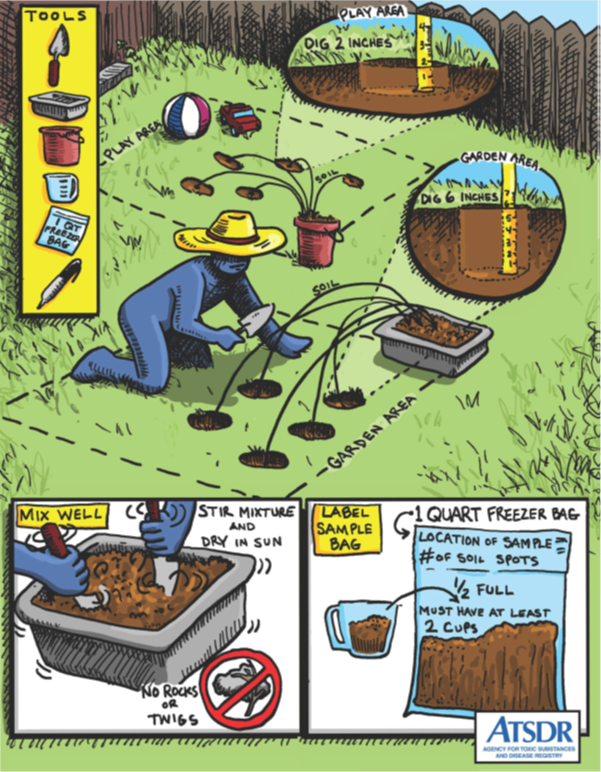
Step 1: Choose a location to sample from (garden, play area).
Step 2: Collect your soil. For garden areas, collect 5-10 soil samples from 6 inches deep. For play areas, collect 5-10 soil samples from 2 inches deep.
Step 3: Mix the 5-10 soil samples from a specific area in a clean container. Keep your garden area and play area soil samples separated.
Step 4: Remove pebbles, rocks, and twigs from the soil samples and make sure the sample is dry. We cannot screen a wet soil sample. Do not use a flame, oven, or hairdryer to dry the soil! You can leave it in the sun to dry.
Step 5: Transfer 1-2 cups of well mixed dry soil into a clean one-quart resealable plastic bag. If you want two areas tested (a garden area and a play area), you need to bring those samples in two separate one-quart resealable plastic bags – do not mix them together.
Step 6: Label the resealable plastic bag(s) and bring them to the soilSHOP event!
Prefer to see an example? Check out this video on how to collect a soil sample.
Though there are many benefits to screening soil during a soilSHOP event, there are some limitations.
- soilSHOPs are used as a way to screen soil for levels of heavy metals only.
- Screening results are not as reliable as laboratory testing results. If you’d like to test your soil for lead, you can visit Wisconsin Occupational Health Laboratory for more information.
- Soil screening results cannot identify sources of lead or arsenic. Screening results cannot be used to characterize an entire yard or soil area - they provide a snapshot of soil in an area and are not an in-depth sampling strategy or plan.
- Soil screening results reflect current soil quality. Environmental changes or building renovations can create soil contamination in the future. Follow Environmental Protection Agency’s Lead-Safe Certified Guide to Renovate Right to prevent future exposures.
soilSHOP resources
- Instructions for creating a raised garden bed (PDF).
- The soilSHOP screening results are a snapshot of soil quality from when the samples were taken. Future building renovations and environmental changes can worsen soil quality. Follow Environmental Protection Agency’s Lead-Safe Certified Guide to Renovate Right to prevent future exposures.
- The only way to know if a child has been exposed to lead is to have them tested. Learn more about blood lead testing in our Childhood Blood Lead Testing 2 By 2 Brochure, P-03557A (available as a PDF in English, Spanish, Hmong) and How to Talk with your Child’s Doctor about Lead Testing, P-03557J (available as a PDF in English, Spanish, Hmong).
- Our What to Know about Lead in Soil, P-03776 (PDF) offers more information about ways to protect yourself and your family from lead in soil.
- Contact the Wisconsin Occupational Health Laboratory for more information on lead in soil testing.
More resources
Soil quality resources
Visit the lead-safe Wisconsin and arsenic webpages for more information on sources and how to prevent other exposures.
Lead and arsenic are not the only harmful substances that could be in soil. Learn more about how harmful substances in soil can enter the body and buildings:
- Brownfield properties in communities may impact soil quality and safety at your home and child care center due to previous chemical contamination.
- Contamination from past chemical spills can leak into the ground and stay for many years. Some of these chemicals can impact the air you breathe by turning into vapors and moving along the soil into cracks or gaps in foundations of nearby buildings through a process called vapor intrusion.
- Waste from former manufactured gas plants is considered hazardous and can also be found in soil near these industrial sites.
- Visit our chemical list webpage for more information on a specific chemical.
Childcare program resources
- Consider participating in the Choose Safe Places program to get a free virtual environment assessment and resources on addressing environmental hazards in your child care center.
- Visit Lead in Schools and Child Care Centers for more information on sources of lead and available resources.
- Consider participating in the Lead-In-Water Testing and Remediation Initiative for free lead-in-water testing and plumbing fixes.
- Visit the Children’s Environmental Health Network’s Protecting Children from Lead Exposure in Child Care and Concerns with Arsenic and its Impact on our Lives for more resources.
Questions?
Can't find what you're looking for? Contact us at DHSEnvHhealth@dhs.wisconsin.gov.
This webpage was made possible by a cooperative agreement [program # CDC-RFA-TS-23-0001] from the Agency for Toxic Substances and Disease Registry (ATSDR). Its contents are solely the responsibility of the Wisconsin Department of Health Services, Site Evaluation Program and do not necessarily represent the official views of the ATSDR, or the U.S. Department of Health and Human Services.