


Environmental Health: Biomonitoring
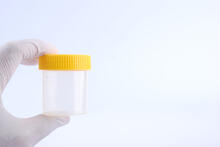
The Wisconsin State Biomonitoring Program is studying environmental contaminants through a community biomonitoring project, the 2025-2026 Wisconsin Rural Health Study, to better understand metal, pesticide, and nitrate exposures among Wisconsin's rural communities. Environmental contaminants are substances introduced to the environment, either naturally or through human activities such as industrial processes, agriculture, and waste disposal. These contaminants can potentially harm humans, animals, plants, and microorganisms.
Biomonitoring is a way of measuring the amount of contaminants, or possibly harmful substances, in a person’s body that come from an outside source. When a person comes into contact with contaminants, this is called an exposure. Exposures can include breathing in, swallowing, or having skin contact with contaminants. Exposures can also come from contaminants in air, water, food, and commercial products. Many contaminants are not harmful, but continued exposure over time may cause health problems. Using special laboratory methods, we can detect these contaminants in a person’s body by testing samples, such as blood, saliva, or urine.
With the support of the CDC (Centers for Disease Control and Prevention) State Biomonitoring Grant, we collected urine samples from participants in rural communities in the western, central sands, and south central regions of Wisconsin. These samples were tested to measure levels of metals, pesticides, and nitrate. We also surveyed participants on demographic, housing, and behavioral characteristics to gather information on how people may be exposed to these contaminants. Some qualifying participants also provided well water samples that were tested for pesticides and nitrogen (nitrate plus nitrite).
Why is this project important?
There is an urgent need for expanding our biomonitoring in rural Wisconsin. Over 25% of Wisconsin residents live in rural areas and over 900,000 households rely on drinking water from private wells. Due to Wisconsin’s unique geology and agricultural practices, many of these wells are vulnerable to (or affected by) natural and human sources of contamination like metals, pesticides, nitrate, and more.
State testing found that almost half of private wells sampled had levels above one or more water quality standards that were developed to help protect people’s health. With less than 10% of private well owners testing their wells regularly, there is a lack of data on environmental contaminant exposures in our rural communities. Measuring contaminant levels through this biomonitoring project can help us to understand what areas may be affected by exposures and find ways to protect these communities.
Wisconsin also has a lot of farms and acres of harvested cropland. The state's largest crop yields are in corn and soybeans, which have some of the heaviest application of pesticides in the U.S. Exposure to pesticides can lead to both short-term and long-term health effects, depending on the type of pesticide, amount of exposure, and an individual’s sensitivity. Pesticides are still being studied to understand the long-term or chronic effects on human health, and scientists are still learning what levels of pesticides are safe in humans.
What are the project's goals?
This project aims to support rural communities throughout Wisconsin by increasing awareness and understanding of:
- How metals, pesticides, and nitrate can impact health.
- How to reduce one’s potential exposures to metals, pesticides, and nitrate.
- The importance of regularly testing private well water.
Findings from this project will increase our understanding of:
- Exposure to metals, pesticides, and nitrate among Wisconsin's rural residents.
- What characteristics (for example, geographic, social, behavioral, and demographic) are associated with higher levels of metals, pesticides, and nitrate.
- How metal, pesticide, and nitrate levels may have changed in the last 10-15 years.
Results from this project can help to inform health services and outreach, improve policies, and advance our understanding of environmental health in rural communities.
Who is participating?
Our biomonitoring project took place among rural communities that have a higher possibility of exposure to groundwater contaminants and that depend on private wells and groundwater for drinking water. Residents in rural areas that regularly carry out agricultural practices have an increased possibility of exposure to harmful pesticides. With less than 10% of private well owners regularly testing their wells, this population may be unaware of their potential exposures through contaminated drinking water. They may also have access to fewer resources to reduce or address any exposures, if they occur.
Project participants are rural community members who previously had urine samples and survey data collected with the University of Wisconsin-Madison’s Real-world Evidence to Advance Community Health (REACH) Program, formerly called the Survey of the Health of Wisconsin (SHOW). We worked with these participants to get a better understanding of how environmental contaminant exposures may have changed over time.
Eligible participants were selected from this group by looking at residents living in three rural regions of Wisconsin with a high percentage of agricultural crop cover in the area immediately surrounding their residence. We focused on the south central, central sands, and western regions of the state. The central sands region refers to the sandy soil left by glacial deposits. It is a distinct feature of this heavily farmed area.
The project included 600 participants who consented to participate in future studies and who have their data saved with REACH. We followed up with 296 of these 600 participants to collect new urine samples, survey data (on demographic, housing, and behavioral characteristics), and well water samples from 100 of the 296 participants who qualified for well water testing.
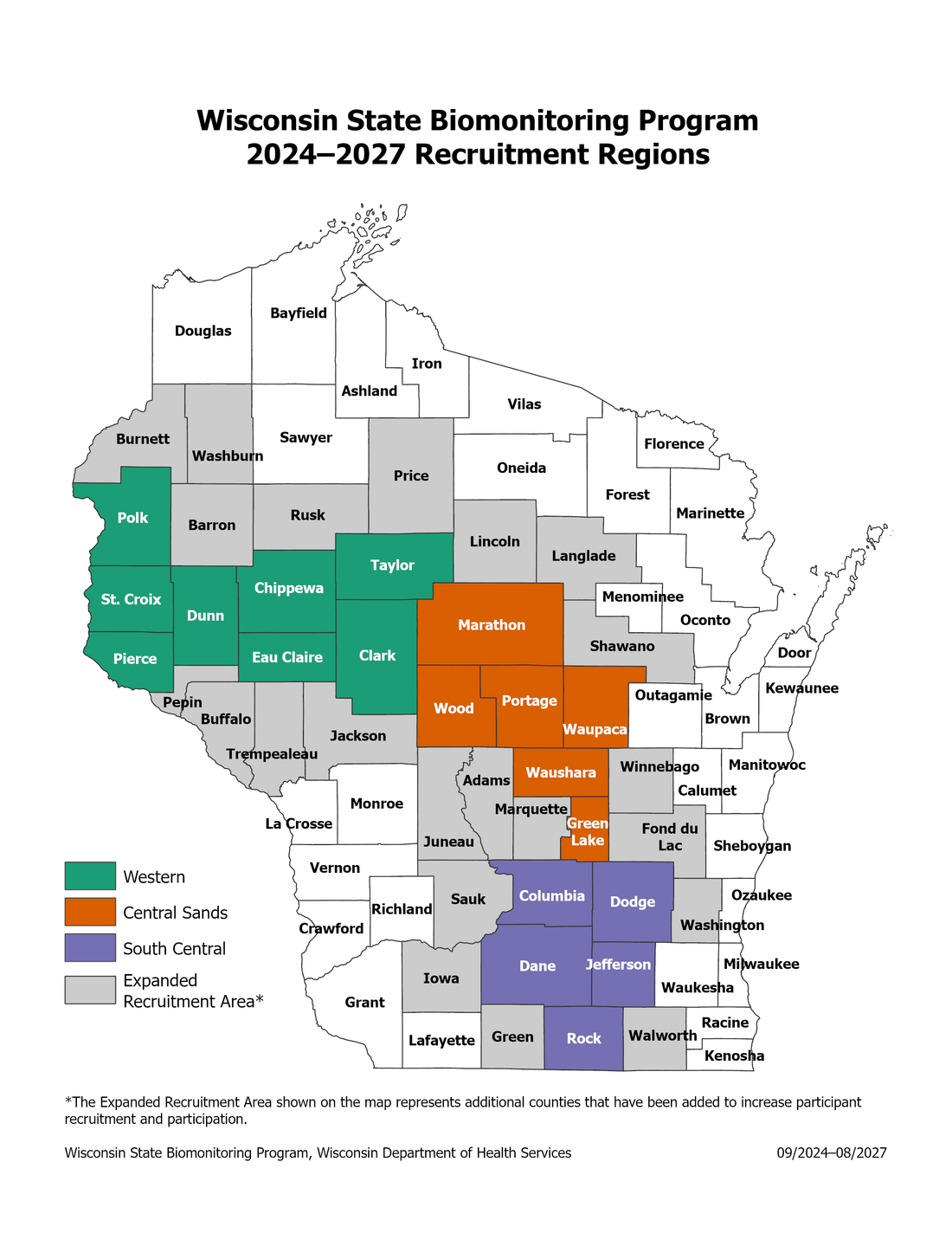
The map shows where the Wisconsin State Biomonitoring Program recruited participants for the 2025-2026 Wisconsin Rural Health Study. This three-year project is taking place during 2024-2027, with participant recruitment and participation occurring during 2025-2026. The counties where we recruited participants are highlighted with different colors to indicate which project region (western, central sands, and south central) the county is a part of, or if it’s part of our expanded recruitment area.
- Western region counties include: Polk, St. Croix, Pierce, Dunn, Chippewa, Eau Claire, Taylor, and Clark.
- Central sands region counties include: Marathon, Wood, Portage, Waupaca, Waushara, and Green Lake.
- South central region counties include: Columbia, Dodge, Dane, Jefferson, and Rock.
- Expanded recruitment area counties include: Burnett, Washburn, Barron, Rusk, Price, Lincoln, Langlade, Shawano, Winnebago, Fond du Lac, Washington, Walworth, Green, Iowa, Sauk, Juneau, Adams, Marquette, Jackson, Trempealeau, Buffalo, and Pepin.
A footnote explains that the expanded recruitment area shown on the map represents additional counties that have been added to increase participant recruitment and participation.
What are the samples being tested for?
The environmental contaminants that we’re studying include certain metals, pesticides, and nitrate. These contaminants were chosen based on their potential health effects, common use of the selected pesticides in commercial agriculture, and recommendations from experts. Initial plans for the project focused on testing urine samples for metals (lead and arsenic) and pesticides. In the second year of our project, we were able to expand our testing to include other metals (cadmium and mercury) as well as nitrate.
Nitrate is naturally found in the air, soil, and water at low levels. It can also be found at small amounts in certain foods (e.g. cured meats). Contamination from fertilizer applications, human waste, and animal waste can cause higher nitrate levels in groundwater. People are most commonly exposed to nitrate through drinking water, and nitrate is one of the most common groundwater contaminants in Wisconsin.
The following tables provide information about our list of pesticides and metals.
| Pesticide | Common Trade/Product Names |
|---|---|
| Acetamiprid | Argyle, Assail, Retriever |
| Acetochlor | Degree, Fearless, Harness, Warrant, Keystone, SureStart, Surpass, Volley |
| Alachlor | Lariat, Lasso, Chimicolor, Alanox, Pilarzo |
| AMPA | AMPA is a chemical resulting from the breakdown of glyphosate in soil. See Common Trade/Product Names for glyphosate. |
| Atrazine | Aatrex, Atram, Atratol, Gesaprim, Aminotox 500 |
| Carbaryl | Sevin |
| Chlorantraniliprole | Coragen, Altacor |
| Clothianidin | Aloft, Olympia Insecticide, Stall, Dome |
| Cyanazine | Bladex, Payze, Fortrol |
| Cyantraniliprole | Exirel, Verimark, Benevia, Fortenza, Spinner |
| Flumetsulam | Python, Frontrow, TripleFLEX/SureStart, Smackdown, and Staunch |
| Glyphosate | Roundup, Touchdown, Glyphomax, FarmWorks, Landmaster, Sequence, OneStep, Costarr, Journey |
| Hexazinone | Pronone, Velpar, Oustar |
| Imidacloprid | Kohinor, Admire, Advantage, Gaucho, Merit, Confidor, Hachikusan, Premise, Prothor, Winner |
| Isoxaflutole | Balance Flexx, TriVolt, Corvus |
| Linuron | Linex |
| MCPA | MCP amine, Trimec Ester, Triamine, Power Zone |
| Mesotrione | Argos, Callisto, Motif, Realm Q, Resicore XL, Acuron, Helmet Maxx, Acuron GT, Coyote, Harness Maxx, Halex GT |
| Metalaxyl | Ridomil, Cruiser Maxx, and Vibrance |
| Metolachlor | Helmet, Parrlay, Zone Elite, Helmet Maxx |
| Napropamide | Devrinol |
| Norflurazon | Predict, Solicam |
| Saflufenacil | Sharpen, OpTill, Zidua Pro, Verdict, Surtain |
| Sulfentrazone | Dismiss, Zone, Spartan |
| Thiamethoxam | Agricultural products: Cruiser, Cruiser Maxx, Endigo, Helix, Platinum, Avicta, and Actara. Commercial and residential products: Tandem Insecticide, Caravan, Flagship, Bonide Rose Shield, Raid Ant Gel |
| 3,5-Dichlorobenzoic acid (chemical resulting from the breakdown of Propyzamide) | Propyzamide is included under the trade name Pronamide. |
| Triclopyr | Garlon, Grandstand R, PastureGard HL, Pathfinder II, Remedy Ultra, Renovate, Turflon Ester, Confront, Crossbow, Chaser, Redeem R & P |
| 2,4-D | Trimec Ester, Triamine, Crossbow, Chaser, Enlist One, Formula 40, GrazonNext HL, Opti-Amine, Unison, Weedar 64, Cimarron Max, Grazon P + D, Outlaw, Pathway, WeedMaster, Trimec, Endrun, Trimec Ester, Triamine, Landmaster, Avenue South, Speed Zone, Surge |
| Metal | Common Applications |
|---|---|
| Arsenic | Pesticides, treated wood products, industrial chemicals, lead alloys (like lead storage batteries) |
| Cadmium | Batteries, pigments, metal plating, and plastics. Found in smoking tobacco and contaminated air (e.g. secondhand smoke, pollution from processing metal or burning coal) |
| Lead | Historical uses: paint, plumbing, gasoline. Modern uses: batteries, ammunition, construction materials, cosmetics |
| Mercury | Historical uses: pesticides, batteries, thermometers, electronic switches and lighting, paints and pigments, certain types of dental fillings (currently being phased-out of use). Modern uses: manufacturing (like fluorescent lighting and electronics). Food is the most common source of exposure (e.g. fish, seafood, and rice), can be naturally occurring or due to industrial releases (i.e. pollution) contaminating air, water, or soil |
Our team
Wisconsin Department of Health Services (DHS)
DHS manages the grant’s logistics and facilitates the program’s biomonitoring advisory group.
University of Wisconsin-Madison Department of Population Health Sciences (PHS)
PHS supports data analysis and outreach efforts for the program.
University of Wisconsin-Madison Real-world Evidence to Advance Community Health Program (REACH)
REACH coordinated participant recruitment and sample collection.
WSLH developed laboratory methods to measure the levels of metals, pesticides, and nitrate in samples. In addition, they processed and tested the samples.
Wisconsin Department of Agriculture, Trade and Consumer Protection (DATCP)
DATCP provided well water testing for qualifying participants.
An important part of this work is being transparent and promoting collaboration between DHS and the communities we are reaching out to for this project. To support these efforts, we formed an advisory group of representatives from local community and state agencies, including the south central, central sands, and western regions. Our advisory group members have an interest in, and can provide expertise in, agriculture, rural communities, and environmental contaminants.
The advisory group helps us stay on course with the goals of this project by providing feedback on our methods, performance measures, and educational materials, while continually representing the interests of the communities.
Represented organizations
- Clean Wisconsin
- Columbia County Health Department
- Dodge County Health Department
- Dunn County Health Department
- Dunn County Land & Water Conservation Division
- Eau Claire City-County Health Department
- Pierce County Health Department
- UW REACH
- UW School of Medicine and Public Health, Population Health Institute
- UW-Stevens Point, Center for Watershed Science and Education
- Waupaca County Health Department
- Wisconsin DATCP
- Wisconsin DHS
- Wisconsin Department of Natural Resources
- Wisconsin SLH
- Wood County Health Department
Resources
To learn more about biomonitoring and the work being done across states, check out CDC National Biomonitoring Program Related Resources.
For information about the National Biomonitoring Network, visit the Association of Public Health Laboratories website.
To learn about drinking water in Wisconsin, visit the Drinking Water page for more information from DHS and partnering organizations.
For health professionals and families interested in learning more about investigating and addressing environmental contaminant exposures, visit the Great Lakes Center for Reproductive and Children's Environmental Health website.
Metals
- To learn more about lead poisoning prevention and to find helpful resources, visit the DHS Lead-Safe Wisconsin page.
- To learn more about arsenic and how to prevent exposure, visit the DHS Arsenic page.
- To learn more about cadmium and how to prevent exposure, visit the DHS Cadmium page.
- Visit the DHS Mercury page to learn more about how mercury exposures occur and possible health impacts.
Pesticides
- For information on pesticides in groundwater and drinking water, visit the DHS Pesticides in Private Wells page.
- Learn more about Human Health Issues Related to Pesticides from the Environmental Protection Agency.
Nitrate
Visit the DHS Nitrate and Nitrite page to learn more about how nitrate exposures occur and possible health impacts.
- Find information on private well testing, including Wisconsin's Well Testing Access Program, from DHS on the Private Wells page.
- Learn more about well water testing and how to interpret your well water test results from the Wisconsin DNR.
- For resources to help you understand your well water testing results and identify possible next steps, visit the University of Wisconsin–Madison Division of Extension’s Understanding My Laboratory Results page.
For an overview of the Wisconsin State Biomonitoring Program’s funding, check out CDC Wisconsin Public Health and Environmental Laboratories Funding.
Contacting the program
If you would like to get in touch with the Wisconsin State Biomonitoring Program:
- Email: DHSEnvHealth@dhs.wisconsin.gov.
- Call: 608-266-1120.
News and publications
Wisconsin receives bio-monitoring program funding (Channel 3000)