


Radon and Your Health
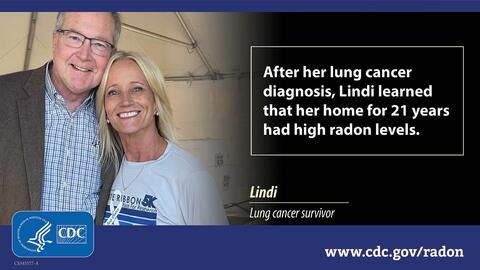
Radon can cause lung cancer
Exposure to high levels of radon over long periods of time can cause lung cancer.
Radon is the leading cause of lung cancer among non-smokers and the second leading cause of lung cancer overall. Radon is responsible for about 21,000 lung cancer deaths every year in the United States.
About 2,900 of these deaths occur among people who have never smoked. For people who smoke, having exposure to high radon increases the risk of lung cancer by 10 times.
Lung cancer is by far the leading cause of cancer deaths, accounting for 1 in 5 of all cancer deaths in the U.S. In Wisconsin, lung cancer deaths outnumbered all colon, breast, and prostate cancer deaths combined (Wisconsin Cancer Collaborative: Lung Cancer in Wisconsin Report, PDF).
The most effective ways to reduce your risk of lung cancer are to quit smoking or vaping and test your home for radon.
For homes with radon levels of four picocuries per liter (4 pCi/L) or higher, the Wisconsin Department of Health Services (DHS) recommends radon mitigation.
Risk of lung cancer from radon
Average Radon Exposure | Lifetime risk of lung cancer from radon for persons who never smoked | Lifetime risk of lung cancer from radon for current smokers |
|---|---|---|
10 pCi/L | 18 in 1,000 | 150 in 1,000 |
8 pCi/L | 15 in 1,000 | 120 in 1,000 |
4 pCi/L | 7 in 1,000 | 62 in 1,000 |
2 pCi/L | 4 in 1,000 | 32 in 1,000 |
1.3 pCi/L | 2 in 1,000 | 20 in 1,000 |
Based on 1999 NAS Report
Lung cancer screening
The goal of lung cancer screening is to find cancer at an earlier stage, when it may be easier to treat. Screening for lung cancer is done with a low-dose computer tomography (CT) scan. For this scan, a person lays on a table in a donut-shaped machine were a computer takes detailed images of the lungs. A doctor reviews the image looking for abnormal spots that may be cancerous cell clusters. It is not an invasive procedure. No IV or needles are involved. Use the American College of Radiology tool to find a lung cancer screening center near you.
A person may qualify for free lung cancer screening if they:
- Are 50 – 80 years of age
- Have a 20 pack-year history of smoking (one pack a day for 20 years or two packs a day for 10 years)
- Are a current smoker or has quit within the last 15 years
If you think you qualify, talk to your doctor to learn more. Even if you do not qualify for free screening, your doctor can still provide you with a referral.
Costs associated with lung cancer screening vary. However, the average cost of lung cancer screening without insurance is $100-$400. The American Lung Association tool (PDF) can help you navigate potential coverage. Those who do not qualify for free screening can explore payment options with or without insurance by calling a Lung Health Navigator at the American Lung Association (ALA). Visit ALA's website for more information on low-dose lung cancer screening.
A low-dose CT lung cancer screening could save your life
If lung cancer is caught before it spreads, the likelihood of surviving five years or more improves to 64 percent.
Resources
Get lung cancer screening support
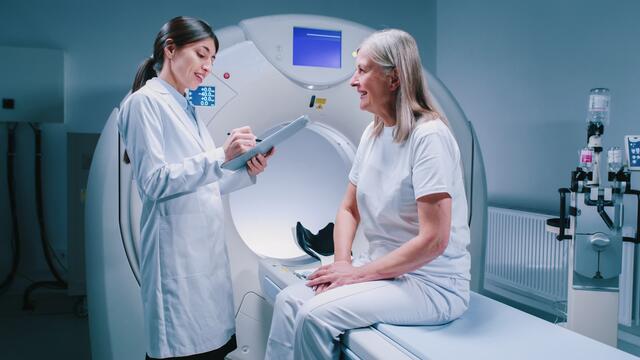
Talk to an American Lung Association (ALA) Lung Health Navigator for support and to see if you quality for screening.
Get your home tested for radon
Testing is the only way to know if you are being exposed to high levels of radon.
Help to quit

Get help to overcome commercial tobacco and nicotine addiction.