


Oral Health Program: Professional Resources

Browse different oral health resources for health care professionals.
Oral health
- American Association of Public Health Dentistry: Aims to improve total health for all through the development and support of effective programs of oral health promotion and disease prevention.
- MouthHealthy, American Dental Association (ADA): Learn more about dental health topics A-Z, Download how to brush (PDF) patient education sheet, and share how to videos for brushing and flossing with patients.
- Publications for Consumers, National Maternal and Child Oral Health Resource Center: Find educational materials for consumers in English and other languages. Materials are easy to read for all audiences.
- Smiles for Life Oral Health, English- Spanish: A national oral health curriculum. Download patient tools and resources and patient education posters in multiple languages.
- World Dental Federation Educational Module for other healthcare professionals: Find various fact sheets and infographics on oral health and systemic disease, pregnancy, hygiene, dietary advice, etc.
- Screening Resource Guide, P-00224 (PDF): Provides images of healthy teeth and oral lesions, tooth eruption chart, fluoride varnish facts, and oral health tips.
- Age 1 Dental Visit, CHAW: Information on babies first dental visit.
- American Academy of Pediatrics: Oral Health: Education, training, and advocacy for pediatricians, dentists, other health professionals, and families. Use the Oral Health Prevention Primer to help address oral health in practice.
- Nutrition Counseling for Obesity Prevention in Children: A Handbook for the Dental Community: Evidence-based resource for practicing dental professionals, oral health-related organizations, community health centers with dental clinics, and other academic programs interested in playing a role in childhood obesity prevention and comprehensive efforts to raise healthy, smiling children.
- Bright Futures in Practice: A national health promotion and prevention initiatives that provides theory-based and evidence-driven guidance for all preventive care screenings and health supervision visits.
Other resources
- Dental Care During Pregnancy is Safe and Important (PDF): Fact sheet explaining the safety and importance of dental care during pregnancy and provides tips on oral care.
- First Breath: Wisconsin’s free program to help people make positive changes to their commercial tobacco, alcohol, and substance use during pregnancy and beyond.
- Oral Health Campaign Toolkit: Customizable materials for patient outreach and education around oral health as well as clinical resources to help integrate oral health into practice. Providers find conversation tactics for talking with patients about the safety and importance of dental care during pregnancy (PDF), healthy tips, and more.
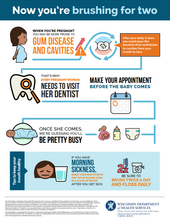
Brushing for Two: Infographic, P-90033a, English-Spanish: Fact sheet containing information about caring for a pregnant person's mouth.
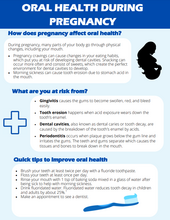
Oral Health During Pregnancy, P-00137 (PDF): Learn how oral health changes during pregnancy, understand why oral health matters, and find tips to keep a pregnant person and their baby healthy.
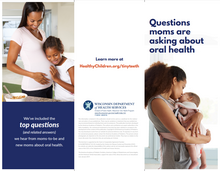
Provider Guide: Questions Moms are Asking About Oral Health, P-90032, English-Spanish: Trifold brochure answers questions about oral health during pregnancy and caring for an infant's mouth.
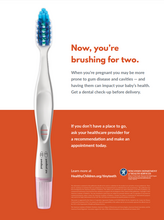
Brushing for Two: Poster, P-90033, English-Spanish: Reminds pregnant people to get a dental check-up before delivery.
Diabetes and oral health
Periodontal disease
Diabetes or high blood glucose leads to health complications including bacteria growth that causes periodontal disease. Periodontal disease involves inflammation and infection of the gum and bone that surround and support the teeth. It weakens the supporting structures of the teeth, leading to bone loss that loosens the teeth and ultimately causes tooth loss. Tooth loss leads to difficulties in eating, speaking, and living a healthy life.
Diabetes and periodontal disease have a bi-directional relationship, meaning one condition can impact the other condition. Research suggests that periodontal disease may be a precursor to insulin resistance and that hyperglycemia in diabetes can promote the growth of bacteria that causes periodontal disease. Both conditions generate a systemic inflammatory response that disrupts insulin signaling and promotes insulin resistance through increased production of pro-inflammatory cytokines. Hyperglycemia causes the production of cytokines responsible for activating osteoclasts that break down the bone in the mouth.
Dry mouth
Uncontrolled diabetes also leads to the development of dry mouth. Dry mouth leads to bacteria growth that increases cavities and worsens gum disease. Other oral symptoms of diabetes include burning sensations or painful white patches in the mouth and delayed healing.
Both diabetes and periodontal disease can be successfully managed when people receive care and treatment from medical and dental professionals. By increasing collaboration between medical and dental professionals, people with diabetes can improve their health outcomes.
In Wisconsin, access to medical and dental care for those with diabetes differs:
- About 94% of adults with diabetes had a medical visit in the past year.
- Only 66% of adults with diabetes had a dental visit in the past year.
- Adults with diabetes are two times more likely to experience severe tooth loss (six or more teeth) due to periodontal disease or tooth decay.
Adults with diabetes who did not have a dental visit in the past year are more likely to report severe tooth loss due to periodontal disease or tooth decay. The frequency of dental visits among those with diabetes is significant to their oral health as tooth loss impacts quality of life, including eating, speaking, working, pain, and more.
Gaps in access to care are also present across factors like socioeconomic status, demographics, transportation access, and household characteristics, called the Social Vulnerability Index (SVI). Adults with diabetes living in counties with high social vulnerability scores are less likely to receive a dental visit within the past year compared to those living in counties with low social vulnerability scores.
Review Oral Health and Diabetes: Why it Matters, P-03751 (PDF) to learn more.
As a medical, dental, or health care provider, you play a role in closing the medical dental gap. Data shows people with diabetes in Wisconsin are more likely to visit a medical provider than a dental provider. These findings support the need to identify interprofessional opportunities for medical and dental providers to collaborate and implement medical dental integration (MDI) strategies for people with diabetes to receive routine medical and dental care. MDI strategies can improve the overall health of Wisconsin residents with diabetes.
You can start by:
- Understanding the risk and connection between oral diseases and diabetes, including the role periodontal disease plays.
- Breaking down health care silos by building relationships between medical and dental providers in your community to create bi-directional communication.
- Educating patients on the connection between diabetes management and oral health.
- Developing interprofessional connections.
For medical providers:
- Ask patients about any oral health issues they may be experiencing and encourage good oral hygiene.
- Encourage patients to receive routine dental care.
- Facilitate referrals to dental care for anyone who hasn’t had a routine dental exam in the past 12 months.
- Connect patients struggling to find care with a community health worker to assist them with finding dental care.
For dental providers:
- Educate dental team on oral manifestations associated with diabetes.
- Screen patients for diabetes and refer them to a primary care provider for diagnosis.
- Encourage patients with diabetes to check their blood sugar, take medications as directed, and attend medical appointments as recommended, including routine exams.
- Discuss your patient’s last medical visit and the results of their last A1C test during their health history review.
- Identify an internal champion interested in the topic to lead systems change and build interprofessional relationships.
Commercial tobacco and oral health
Wisconsin Tobacco Quit Line
Free 24/7, customized plans and coaching
Ages 13+
1-800-Quit-Now
Text "READY" to 34191
Wisconsin Tobacco Quit Line website
Live Vape Free
Text support to quit e-cigarettes
Ages 13-17
Text "VAPEFREE" to 873373
Live Vape Free website
American Indian Quit Line
Culturally tailored coaching
Ages 18+
1-888-7Ai-Quit
American Indian Quit Line website
First Breath
Support during and after pregnancy
Ages 18+
First Breath website
- Medicaid/BadgerCare and Quitting Tobacco Fact Sheets: Medicaid/BadgerCare coverage for tobacco-dependence treatment applies to treatment provided by any Medicaid-certified Wisconsin physician, nurse practitioner or physician assistant.
- Tobacco Fact Sheets, English-Hmong-Spanish: Comprehensive list of free materials to be reprinted and distributed by health care professionals and others.
- UW-CTRI Treatment by Specialty: Tobacco treatment resources for dentists and dental hygienists including trainings, toolkits, videos, and fact sheets.
- Tobacco Education Resource Library: Information focused on public health education, smoking cessation, tobacco research, retailer information, tobacco regulations, and compliance—all in one place.
- Implementing & Fostering QuitLine Referrals: A Guide for Oral Health Professionals: A toolkit that offers dentists guidance on managing and how to refer patients to State QuitLines to support tobacco and vaping cessation efforts.
Oral cancer
- Wisconsin Cancer Collaborative (WCC), WCC: Public, private, and community organizations work together to network, learn facts and figures, and share resources as they work to reduce the oral cancer burden in Wisconsin.
- HPV-Related Cancers and Vaccination Coverage in Wisconsin (PDF) explains, in Wisconsin the most common cancer caused by HPV is oropharyngeal cancer. HPV vaccine safely and effectively prevents cancer, however, the majority of Wisconsin children are not completing their HPV vaccination series. Learn the impacts of COVID-19 and action steps for improving vaccination rates and saving lives. Cancer organizations network, learn facts and figures, and share resources as they work to reduce the oral cancer burden in Wisconsin.
- Learn more about oral health topics through issue briefs, discover infographics available in several languages, and download how-to-sheets to share with patients.
- Detecting Oral Cancer: A Guide for Healthcare Professionals (PDF): Poster with full-color photographs depicting each stage of the oral cancer examination. Find information to share with patients on oral cancer topics. Download or order free printed copies of publications.
- Head and Neck Cancers—Health Professional Version: Information on screening for head and neck cancers, their causes, symptoms, and treatments. Learn more about current statistics and research.
- HPV Toolkit for Dental Professionals: Download HPV toolkit containing educational materials and resources that can be reproduced and distributed.
Not finding what you need?
Reach out to the Oral Health Program. Contact us and Sign Up for Oral Health Program updates.
- Oral Health Program: Fluoride and Community Water Fluoridation
- Oral Health Program: Data and Reports
- Oral Health Program: Wisconsin Seal-A-Smile
- Oral Health Program: Dental Workforce
- Oral Health Program: Medicaid and BadgerCare Plus for Dental Providers
- Oral Health Program: Opioids and Substance Use Disorders
- Healthcare-Associated Infections: Infection Prevention in Oral Health Settings
- Antimicrobial Stewardship: Resources for Health Care Providers